Table of Contents
Armstrong County Courts, PA *

Armstrong County is a rural county located in the west-central region of Pennsylvania, 40 Miles northeast of Pittsburgh. The county is home to approximately 65,558 people, and its county seat is Kittanning. Armstrong County was named after Revolutionary War hero Major General John Armstrong. Understanding the Armstrong Court System is necessary for individuals pursuing legal matters in the county, as it enables them to navigate it effectively.
The Armstrong County courts handle daily legal issues, criminal and civil, and follow Pennsylvania state law, with many legal procedures centered in Kittanning. In addition, there are several courts, different case types, court procedures for filing cases, and procedures for accessing court records that residents and non-residents of Armstrong County should understand in order to handle any legal matter within the Armstrong County Court System effectively and efficiently.
Overview of the Armstrong County Court System
The Armstrong County Courts System consists of two main courts: the Armstrong County Court of Common Pleas and four Magisterial District Courts. The Court of Common Pleas has several divisions responsible for handling civil, criminal, family, and probate matters in Armstrong County.
The courts in Armstrong County are part of the 33rd Judicial District Court of the Pennsylvania Unified Judicial System. The Armstrong County Court of Pleas has unlimited general jurisdiction to handle legal cases throughout Armstrong County, while Magisterial District Courts operate with limited jurisdiction within their respective city limits. TheClerk of Courts Office is the legal custodian for court records and is responsible for maintaining, digitizing, retrieving, archiving, and filing records within the Armstrong County Court System.
Types of Courts in Armstrong County, Pennsylvania

Individuals who learn and understand the types of courts in Armstrong County can navigate the Armstrong County Court System more efficiently and successfully than those who don't. They can protect their constitutional rights and avoid costly mistakes such as filing a case in the wrong court.
 Court of Common Pleas
The Armstrong County Court of Common Pleas is a part of the Pennsylvania Unified Judicial System. It is the primary trial court of general jurisdiction in Armstrong County and handles criminal, civil, family law, and juvenile cases. Additionally, the court also hears appeals from the Magisterial District Courts. The Court of Common Pleas has specialized internal divisions responsible for each type of case.
Primary Location: Armstrong County Courthouse
 Criminal Division
The Armstrong County Court of Common Pleas, Criminal Division, handles misdemeanor and felony cases forwarded from the Magisterial District Courts in Armstrong County.Jurisdiction includes:
- Felony criminal cases
- Misdemeanor criminal cases
- Jury trials
- Sentencing hearings
- Probation violations
- Criminal appeals from lower courts
The court's criminal division records are handled by the Clerk of Courts Office, which processes bail, files criminal motions, and collects court-ordered fines or restitution.
Primary Location: Armstrong County Courthouse
 Civil Division
When it comes to non-criminal disputes involving individuals, businesses, or government entities, it's the responsibility of the Armstrong County Court of Common Pleas, Criminal Division.
Jurisdiction includes:
- Civil lawsuits over $12,000
- Contract disputes
- Personal injury claims
- Property disputes
- Business litigation
- Equitable relief requests
The court records from the Civil Division are managed by the Prothonotary Office, the primary custodian of civil trial dockets.
Primary Location: Armstrong County Courthouse
 Family Court & Domestic Relations Division
The Armstrong County Court of Common Pleas, Family Court Division, is responsible for matters involving family and domestic relationships.
Jurisdiction includes:
- Divorce proceedings
- Child custody disputes
- Spousal support
- Paternity testing
- Abuse and restraining orders
The Family Court and Division work hand in hand with the Armstrong County Domestic Relations Section to solve issues regarding minors and children within families.
Primary Location: Armstrong County Courthouse
Orphans' Court Division
The Armstrong County Court of Common Pleas, Orphans' Court Division, handles cases involving people who cannot legally manage their own affairs, such as the estates of people who have died.
Jurisdiction:
- Probate of wills
- Estate administration
- Guardianships
- Trust matters
- Adoptions
The Register of Wills and the Clerk of the Orphans' Court are the custodians of records from the Orphans' Division.
Primary Location: Armstrong County Courthouse
Magisterial District Courts
There are four Magisterial District Courts in Armstrong County. The Armstrong Magisterial District Courts are the lowest level of trial courts in the county. Many residents of Armstrong County get introduced to the court system through these courts. The Magisterial Courts have jurisdiction over the following:
- Traffic violations
- Parking citations
- Summary offenses
- Preliminary hearings for felony and misdemeanor cases
- Landlord-tenant disputes
- Eviction proceedings
- Civil claims under $12,000
- Small claims matters
If an individual is not satisfied with the ruling in their case in the Magisterial District Courts, they can appeal to the Armstrong County Court of Common Pleas.
Primary Location: Various municipal and district buildings throughout Armstrong County
How to Access Armstrong County Court Records

Armstrong County court records are public information and are available for one to view, inspect, copy, print, or download. Court records are available online and in person at the respective Clerk of Courts Offices. One can view any records except for sealed, confidential, or restricted court records.
 Online Access
Residents can access Armstrong County Court records using the official statewide platform, Unified Judicial System of Pennsylvania Portal (UJS). On the UJS platform, one can access court records, including criminal, traffic, civil, family, and divorce records. For additional civil records, one can access the Armstrong County Prothonotary website. Lastly, for deeds, wills, and estates, one can find real estate and land records through the Register & Recorder - Armstrong County.
 Alternative Online Options
Alternatively, one can search for court records from Armstrong County through third-party search engines such as CourtCaseFinder. The platform simplifies the search process by aggregating data from multiple courts and states, allowing users to perform multiple search inputs. Users also experience multi-tiered jurisdiction aggregation, instant, simplified reporting, and high-volume trial access. Such platforms are also great for searching court records across Armstrong County and Pennsylvania, and users can enjoy a nationwide search across multiple states and federal jurisdictions.
 In-Person Requests
In addition to online access, Armstrong County court records are also available in person at the Armstrong County Courthouse. The Clerk of Court in Armstrong County provides the public with terminal and kiosk computers for searching court records. They can also print and download the records. That said, one should visit the office with jurisdiction over their case. For example, for civil, family, and divorce records, one goes to the Prothonotary & Clerk of Courts office, and for wills, estates, and adoption records, one goes to the Register of Wills & Clerk of Orphans' Court. Lastly, for property deeds and mortgages, one goes to the Recorder of Deeds.
 Archived Records
When it comes to Armstrong County records, they are available in various forms and stored in different locations, such as archived, historical, or genealogical court records. Since Armstrong County was formed in 1800, the records go way back. One can access historical records for Armstrong County online through Pennsylvania Court Records on FamilySearch. Alternatively, a comprehensive directory of digitized historical county assets is available through the PA State Archives.
For archived records not yet digitized, one can request them in person at the Armstrong County Courthouse, including Estate & Land Records (1805-1947), available as physical microfilm reels. Lastly, residents can visit the historians at the Armstrong County Historical Museum & Genealogical Society for family history or very old civil cases.
For Attorneys and Legal Professionals
Attorneys and legal professionals in Armstrong County can access court records in person or through the statewide official online platforms. They can review files, manage cases, and handle sensitive or sealed documentation. Unlike the public, who have access only to the regular UJS platform, Attorneys can use their Pennsylvania Bar credentials to access the UJS Portal Restricted eServices. On this special portal, they can enjoy an expanded search of docket contents, unredacted party details, and comprehensive pre-sentence summary reports. Additionally, for case filing and tracking, they can use PACFile Electronic Filing (Statewide & Appellate).
The same rules and procedures apply to visiting attorneys and legal professionals as to the professionals who consistently practice in the county. They should learn and understand how the Armstrong County Court System works. This includes familiarizing themselves with filing procedures, courthouse schedules, motion practices, and judicial assignment rules. Similarly, if they want to file a case, they should bring case identification information, such as the case number, filing year, and party names, which will help speed up the process. If one is unsure, they can confirm with the Clerk's Office to avoid delays and confusion and have a seamless experience.
How to File a Case in Armstrong County

Although one can file a case electronically or in person in appellate or state-level courts, Armstrong County does not allow electronic filing through PACFile for initial civil and family law cases. For such cases, one must file in person through traditional paperwork.
 Step 1: Choose the Correct Court
The first step is to identify the correct court with jurisdiction over the case. For small claims and evictions, one can file with the respective Magisterial District Court. For example, if one is a Ford City resident, they will file at the Ford City Magisterial District Court. This is the same for residents of Kittanning, Leechburg, or Rural Valley. Filing for major lawsuits and family law cases is all done in one location through the Court of Common Pleas.
 Step 2: Complete Required Forms
After identifying the court, one can request the appropriate forms from the respective clerk's office. For example, in a major civil case in the Court of Common Pleas, one must submit a physically bound package containing the civil cover sheet, the complaint or writ of summons, required copies (original and copies for the defendant), and self-addressed envelopes. Residents must use standardized forms, such as the Civil Complaint Form AOPC 308A, and complete the state civil cover sheet. Residents who are unsure which documents to file should ask the Clerk of Courts or the Prothonotary of Anderson County.
 Step 3: File the Case
To file the case, citizens need to submit the papers to the clerk's counter for verification and stamping, including copies for the defendant. This is why it is important to use standardized forms, complete the sections as required, and provide all documents and forms required by the Clerk's Office. If someone is unsure which form they need or how to file, they can always ask the clerk's office for guidance. In Armstrong County, in-person filing is mandatory except for appellate court cases.
 Step 4: Pay Filing Fees
The next step is to pay the statutory fees to the clerk of the court's office. One must pay upfront for the clerk to process their filing. Filing fees can change over time, so it is important to call or visit the Clerk's Office to determine the filing fees for the case. Residents can view the latest costs through the Armstrong County Prothonotary Fee Schedule. Low-income individuals who cannot afford filing fees can apply for a waiver by completing and filing a Pennsylvania In Forma Pauperis Affidavit Petition.
 Step 5: Serve the Other Party
After filing, one must notify the opposing party because the clerk's office doesn't notify defendants. The plaintiff cannot serve the defendant themselves. In Armstrong County, one can use the service of the Armstrong County Sheriff's Department or an adult third party to deliver the stamped copies of the lawsuit. After service, the plaintiff must provide Proof of Service by filing the Return of Service or an Affidavit of Service with the Clerk's Office. The Sheriff can do this on their behalf as well. The court will not schedule hearings or act on the case if proof of service is not provided.
 Step 6: Monitor the Case
The last step of the filing process is to monitor the case. By monitoring cases, the plaintiff will know whenever there are updates, such as when the defendant has filed a response or when there are upcoming court dates. For cases of the Magisterial District Court, such as minor criminal cases, small claims, and traffic violations, one can monitor through the Unified Judicial System of Pennsylvania Portal. The best way to monitor cases in civil, divorce, or family law filed with the Court of Pleas is to visit the Prothonotary & Clerk of Courts Office in person. Alternatively, those who cannot reach the clerks in person can call to provide details of their case and receive direct updates.
Armstrong County Courthouse Directory
The Armstrong County Courthouse Directory is helpful to members of the public and legal professionals because it provides directions to Armstrong County Courts operating under the 33rd Judicial District Court of the Pennsylvania Judicial Court System.
Armstrong County Courthouse (Court of the Pleas)
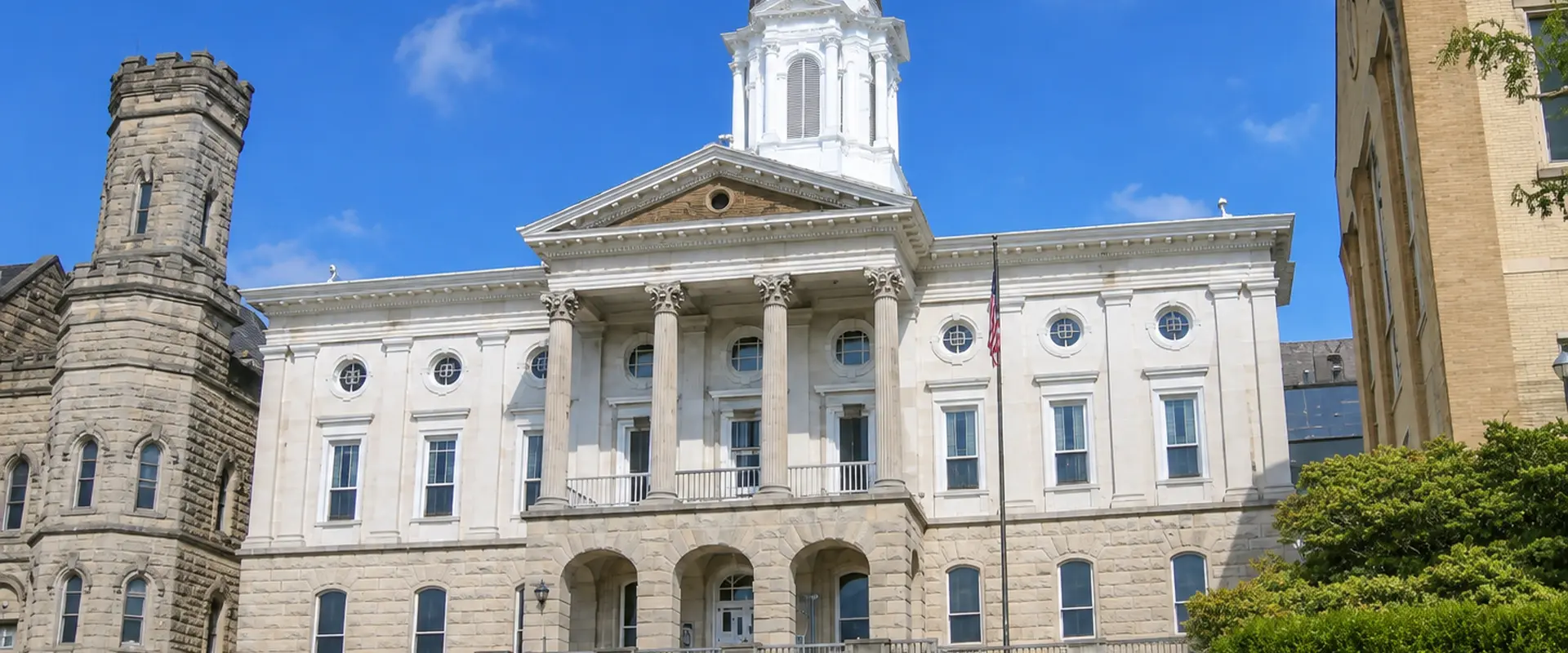
The Armstrong County Courthouse is the center of operations of the Court of the Pleas, including the Criminal Division, Civil Division, Family Court Division, and the Orphans Court Division.
Kittanning
Address: 500 E. Market Street, Kittanning, PA 16201
Phone: (724) 543 2500
Website: Armstrong County Courts
Magisterial District Courts
There are 4 Magisterial District Courts in Armstrong County, all handling legal matters within their city limits. Because court schedules vary with different courts, one is required to call before visiting to confirm office hours.
District 33-3-01 (Ford City)
206 5th Ave, Suite A, Ford City, PA 16226
(724) 763-7866
District 33-3-02 (Kittanning)
128 S Grant Ave, Kittanning, PA 16201
(724) 543-2313
District 33-3-03 (Leechburg)
241 Market St, Leechburg, PA 15656
(724) 842-3571
District 33-3-04 (Rural Valley)
720 Main Street, Rural Valley, PA 16249
(724) 783-6886
Legal Help and Self-Help Resources
Legal help and self-help resources are available for self-representing, elderly, and low-income individuals pursuing justice in the Armstrong Court System. These include free public self-help centers, pro bono civil defense organizations, and specialized legal helplines.
 Free Legal Assistance
Elderly individuals aged 60 and older in Armstrong County can receive help with drafting simple wills, filing powers of attorney, preparing living wills, handling landlord-tenant disputes, and navigating public benefits or disability applications through the Armstrong County Agency on Aging Legal Services Program. Alternatively, individuals representing themselves can download court forms and step-by-step instructional guides for self-representation through PALawHelp. Lastly, individuals facing criminal cases who cannot afford an attorney will be provided a court-appointed attorney by the Armstrong County Public Defender's Office.
 Local Legal Support
Individuals with low incomes can receive free representation in non-criminal matters, such as landlord-tenant disputes, public benefits appeals, foreclosures, and custody disputes, through Summit Legal Aid. The Summit Legal also prioritizes helping victims of domestic violence by providing immediate protection from abuse (PFA) orders. Additionally, one can request Pro Bono local attorneys in Armstrong County who volunteer their services through the PA Bar Association Pro Bono Program. Lastly, low-income individuals in need of civil legal help for civil issues such as landlord-tenant evictions, mortgage foreclosures, child custody disputes, protection from abuse (PFA) Orders, and public benefit denials can find help through the Pennsylvania Legal Aid Network (PLAN).
FAQs
How do I search for a criminal case in Armstrong County?
One can search for a criminal case in Armstrong County, PA, for free using the Pennsylvania Unified Judicial System (UJS) Portal. Once on the UJS portal, one can search by Participant Name or Docket Number and Criminal Docket Type. After that, they can enter the name and click search. Alternatively, one can search for records in person at the Clerk ofCourts Office.
Are court records public in Armstrong County?
Yes, Court records are public information in Armstrong County. The state's judicial open records policies ensure that court records from the Armstrong County Courts are provided online or in person at the Clerk's Office. One can find criminal records and civil records, except for sealed or restricted records. One can see docket sheets, calendars, and filing timelines. Confidential information, such as Social Security numbers, accounts, and documents, including custody and juvenile records, is restricted.
How long does it take to get records in Armstrong County?
The time it takes to obtain court records in Armstrong County depends on whether an individual searches online or makes an in-person request at the Clerk of Courts' office. Individuals who search online using the UJS Judiciary Web Portal receive instant results for free. Similarly, for In-Person Counter Requests, one can find court records the same day. The only time it takes longer is when one has to submit a Pennsylvania Right-to-Know (RTK) request for extensive records, which takes 5-35 days.
Are online court record searches always accurate?
No. Online Court records are not 100% accurate. Online portals are reliable, convenient, and easily accessible. These online platforms are great for tracking cases and personal research. But sometimes, one may get inaccurate search results because the clerk's office has uploaded incomplete documents. Additionally, if they make clerical human errors, such as searching for the wrong name, date, or formatting, they may not get the results they are looking for. Even official platforms may be inaccurate because new records take time to update.
When is it helpful to use a third-party records finder?
It is helpful to use a third-party record-finder portal, such as CourtCaseFinder, when searching records across several counties simultaneously. CourtCaseFinder is also excellent when searching for hard-to-find records, especially when one doesn't have complete information, for example, if they don't know the respective court where the records were filed. Or if the name involved in the records is common. The platform allows for centralized searching, flexible querying, time-saving, and provides a broader scope for users to search court records with a mobile-optimized interface.
Other Counties in Pennsylvania
- Adams
- Allegheny
- Beaver
- Bedford
- Berks
- Blair
- Bradford
- Bucks
- Butler
- Cambria
- Cameron
- Carbon
- Centre
- Chester
- Clarion
- Clearfield
- Clinton
- Columbia
- Crawford
- Cumberland
- Dauphin
- Delaware
- Elk
- Erie
- Fayette
- Forest
- Franklin
- Fulton
- Greene
- Huntingdon
- Indiana
- Jefferson
- Juniata
- Lackawanna
- Lancaster
- Lawrence
- Lebanon
- Lehigh
- Luzerne
- Lycoming
- Mckean
- Mercer
- Mifflin
- Monroe
- Montgomery
- Montour
- Northampton
- Northumberland
- Perry
- Philadelphia
- Pike
- Potter
- Schuylkill
- Snyder
- Somerset
- Sullivan
- Susquehanna
- Tioga
- Union
- Venango
- Warren
- Washington
- Wayne
- Westmoreland
- Wyoming
- York
Table of Contents
