Table of Contents
Lackawanna County Courts, PA *

Lackawanna County is one of Pennsylvania's 67 counties. It is a northeastern county in a beautiful area of the Pocono Mountains. Lackawanna County comprises the city of Scranton and its many boroughs and townships, covering an area of over 460 square miles. The Lackawanna County courts handle all matters of civil and criminal cases, family matters, probate, and more.
Each case filed with the Lackawanna County Courts must include proper paperwork, completed and filed with the appropriate division. Meanwhile, background checks, prior evictions, and other research completed by employers, landlords, and many other individuals and companies are contained in the Lackawanna County court records.
Overview of the Lackawanna County Court System
There are several courts located within Lackawanna County. Each court is part of the Pennsylvania Unified Judicial System. Lackawanna County is part of the 45th Judicial District of Pennsylvania. Most counties in Pennsylvania state have courts that are set up and operate in a very similar fashion to those in Lackawanna County. The trial courts located in the county include the Court of Common Pleas and the Magisterial District Courts.
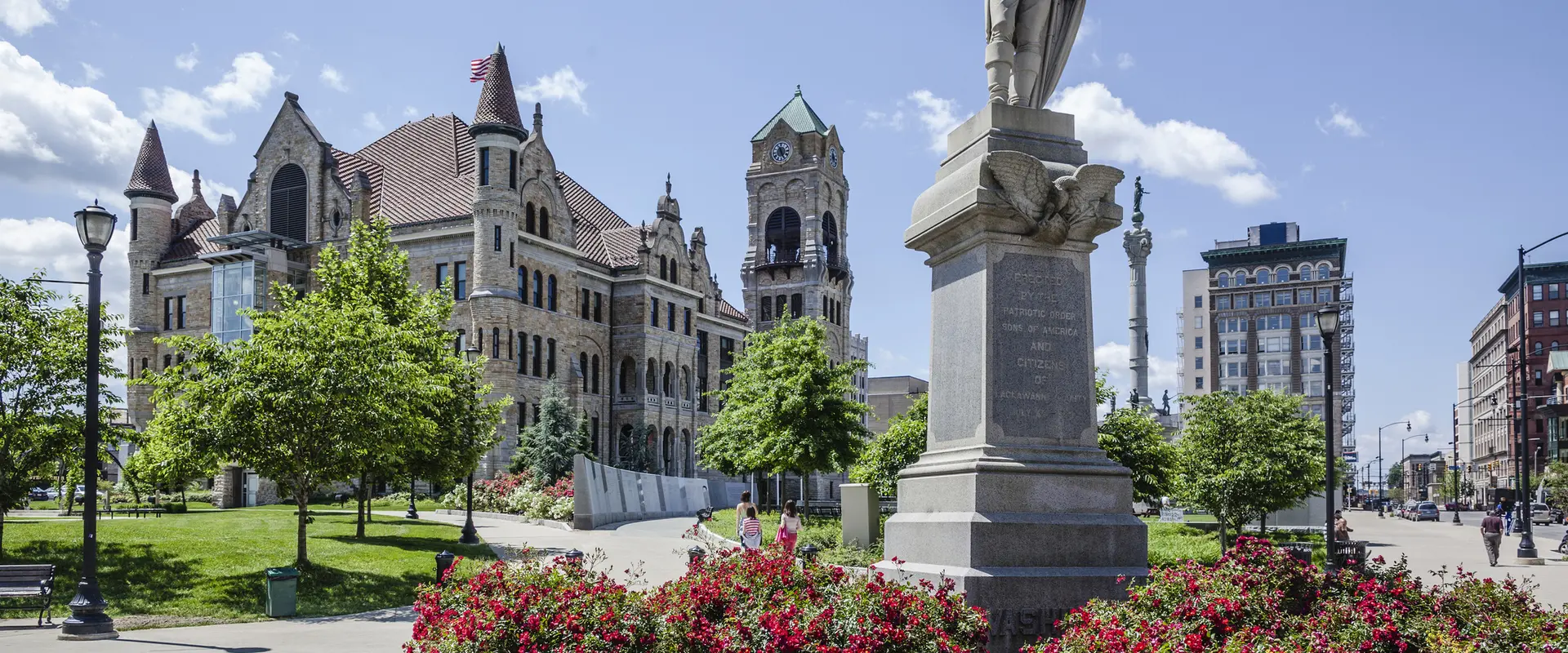
The Lackawanna County Courthouse is located in Scranton and houses the Court of Common Pleas and the administrative offices of all Lackawanna County courts. There are ten Magisterial District Courts located throughout the County, as well as the Centralized Court located in Scranton, and in Dunmore, Dickson City, Archbald, Moscow, Carbondale, and other locations throughout the Lackawanna County area. Civil and criminal filings in Lackawanna County are consolidated into a single office of the Clerk of Judicial Records. In contrast, in many Pennsylvania counties, the Prothonotary and Clerk of Courts are separate offices.
Types of Courts in Lackawanna County, Pennsylvania

Identifying the correct court can have significant consequences, both positive and negative. It is generally determined by the type of case, the amount of money involved, and the relief sought by the party filing the case.
 Court of Common Pleas
The Court of Common Pleas is the highest trial court in Lackawanna County and is part of the 45th Judicial District. It is divided into several divisions within the court, and all of its proceedings take place in the Scranton Courthouse.
The Court of Common Pleas handles:
Criminal Division
- Felony cases (such as serious assaults, drug trafficking, burglaries, etc.)
- Misdemeanor cases
- Specialty courts such as Adult Drug Court, Juvenile Drug Court, DUI court, and Family Drug Court
- Appeals from Magisterial District Courts in criminal matters
Civil Division
- Civil matters exceeding $12,000
- Equity actions and injunctions
- Mortgage foreclosures and complex property disputes
- Medical and legal malpractice cases
- Appeals from Magisterial District Court civil decisions
- License suspension and administrative agency appeals
Family Division
- Divorce, separation, and annulment proceedings
- Child custody, visitation, and parental rights
- Child and spousal support matters
- Paternity proceedings
- Protection from Abuse (PFA) orders
- Juvenile delinquency and child abuse or neglect cases
- Dependency and truancy cases
- Termination of parental rights and adoption proceedings
Orphans' Court Division
- Probate of wills (when a person dies with a valid will).
- Administration of estates (when a person has passed away without a valid will)
- Guardianships of minors and incapacitated persons
- Contested estate claims and accountings
Cases in the Court of Common Pleas can result in lengthy prison sentences, and it is recommended that individuals with such cases secure an attorney before their first day in court.
Magisterial District Courts
The first court most Lackawanna County residents come into contact with in the Pennsylvania court system is one of Pennsylvania's ten Magisterial District Courts, or the Central Court.
Magisterial District Courts handle:
- Traffic citations and infractions
- Summary of criminal offenses
- Civil matters involving amounts up to $12,000
- Eviction and landlord/tenant cases (possession and rent)
- Municipal code and ordinance violations
- Criminal Process: Preliminary arraignments, setting of bail, preliminary hearings, and other matters, including issuance of summons, subpoenas, arrest warrants, and search warrants
- Emergency Protection from Abuse (PFA) after hours (Final PFAs are filed in the Court of Common Pleas)
- Older Adult Protective Service Act emergency relief
Decisions of the Magisterial District Courts can be appealed to the Court of Common Pleas, where the case will be heard de novo. A list of all the Municipalities in Lackawanna County and their contact information can be found on the Lackawanna County Magistrates page.
How to Access Lackawanna County Court Records

Pursuant to the Right-to-Know Law (65 P.S. § 67.101 et seq.), Pennsylvania law permits access to most documents within Pennsylvania Courts. Most court records are available for public inspection unless prohibited by law or the Rules of Court. Examples of records that are restricted or considered confidential are juvenile court records, sealed criminal cases, mental health records, and adoption records.
 Online Access
The Pennsylvania Judiciary portal allows the public to search for criminal dockets and civil case records online across all courts in the Commonwealth. Searches for Lackawanna County Court of Common Pleas and Magisterial District Court records can be conducted on the portal. The more information about a case is provided, such as the full legal names of all parties, case and/or docket numbers, and the specific court office and/or division where the case was filed, the better the results will be.
 Alternative Online Options
Online public records databases can be used to search for Lackawanna County court records. These databases can search across multiple jurisdictions, including civil case files and copies of public records from all courts. Some of these databases compile information from all courts and government offices within a state or even within the entire country. CourtCaseFinder, for example, provides access to civil case files, public records from individual courthouses, and criminal records.
 In-Person Requests
For certified copies of court documents and older records not available online, the Lackawanna County Courthouse can be visited. Parties should come prepared with as much information as possible: docket number, full legal names of parties to the case, etc. The court can provide parties with certified copies of documents at a fee. The Clerk of Judicial Records can search for older documents but cannot provide legal advice.
 Archived Records
Historical court records for Lackawanna County are archived at the Pennsylvania State Archives as well as at the courthouse. Historical court documents can be very useful for genealogical research and for uncovering the history of a property or a long-closed case. Historical probate and estate records can be found by contacting the Clerk of Judicial Records, who can assist in locating the records needed but cannot give legal advice.
For Attorneys and Legal Professionals
The Unified Judicial System (UJS) portal allows attorneys of record before the Lackawanna County courts to access information regarding their cases and review the current court docket. Information and contact numbers for the individual Lackawanna County courts, as well as general information for attorneys, are available on the UJS portal.
All filings must comply with the Pennsylvania Rules of Civil Procedure, the Pennsylvania Rules of Criminal Procedure, and the local rules of the 45th Judicial District. Some case types must be filed electronically. Attorneys can file documents online using the Unified Judicial System's web-based e-filing application. Lead time is required for processing certified copies of documents and historical court records. Additional time is needed to process these requests.
How to File a Case in Lackawanna County

Many errors made by litigants and their attorneys alike can be avoided by saving time and money by correctly filing a case rather than allowing delays.
 Step 1. Choose the Correct Court
Selecting the correct court to have a matter heard promptly is key. Refer to the "Types of Courts" section above for general information on the cases heard in the Court of Common Pleas (Criminal, Civil, Family, and Orphans' Court Divisions) as well as the Magisterial District Courts.
 Step 2. Complete Required Forms
Read all the free resources from the Commonwealth of Pennsylvania. Fill out every required field on every document. Sign all documents that require a signature. Attach all required documents. Incomplete documents are the leading cause of delayed and rejected filings. Pennsylvania government forms are available online at the state's services portal. Forms can also be found at the local County Clerk's office. Staff there can assist applicants with filling out forms and filing them on their behalf, but they cannot give legal advice.
 Step 3. File the Case
To file a matter in a Magisterial District Court, it can be filed in the MDC court of the municipality where the matter arose. This is done in person. When filing a case at the courthouse for a Court of Common Pleas matter, the court staff will review the documents to ensure that all instructions have been completed, that supporting documents are completed in the proper format, and that they are ready for filing. Some types of cases can be filed online through the Pennsylvania court system's online electronic filing service, PACFile, such as civil, family, and Orphans' Court cases. However, not all case types can be e-filed, so it is always best for filers to check with the court where a paper case is being filed to determine which online filing options are available.
 Step 4. Pay Filing Fees
Each type of action has a filing fee for civil cases in Lackawanna County. These fees differ for civil cases filed in the magistrate court versus those filed in the court of common pleas. Information about filing fees can be obtained from the Clerk of Judicial Records. A party may file a petition with supporting documentation to the court for a waiver of fees if they are unable to pay the filing fees.
 Step 5. Serve the Other Party
Service of process must be made on the other party within a certain period after the initial complaint or petition is filed. Service of process can be completed by a licensed process server, by the Lackawanna County Sheriff's Office, or by certified mail return receipt requested. A record of service must be maintained by the party who filed the case, and a copy of the proof of service must be attached to the copy of the complaint or petition that is filed with the court. If service of process is not properly completed on all other parties in a case, the case may be placed on hold or dismissed.
 Step 6. Monitor the Case
Parties with an active case can find information by checking the docket on the UJS portal or by contacting the Clerk of Judicial Records at the appropriate Courthouse location. It is always a good idea to review prior pleadings and evidence before a hearing. Filers can monitor financial information, scheduled court dates, calendar events, and the complete list of filings within the active case.
Lackawanna County Courthouse Directory
Lackawanna County Courthouse
Major civil lawsuits, felony and misdemeanor criminal matters, and other Court of Common Pleas cases are processed here.
Scranton
Address: 200 N. Washington Avenue, Scranton, PA 18503
Phone: (570) 963-6773
Website: Court of Common Pleas
Family Court and Orphans' Court
Scranton
Address: 123 Wyoming Avenue, Scranton, PA 18503
Family Court: (570) 963-6721
Orphans' Court: (570) 963-6702
Magisterial District Courts
Handle criminal matters, summary offenses, traffic citations, small civil claims, and landlord/tenant matters. Complete contact information for all of the Magisterial District Courts in Lackawanna County can be found on the Lackawanna County Magistrates page.
Parties should also check the office hours of operation for the office they plan to visit, as hours and locations are subject to change.
Legal Help and Self-Help Resources
Free legal help or resources for "self-help" by persons who cannot afford a lawyer are provided by many non-profit, local, and statewide organizations.
 Free Legal Assistance
North Penn Legal Services (NPLS) is a non-profit organization funded by federal, state, and county funds to provide free civil legal services to low-income individuals and families residing in northeastern Pennsylvania, including Lackawanna County. In addition, NPLS conducts community legal education to help individuals understand their legal rights and responsibilities.
The Pennsylvania Legal Aid Network (PLAN) is a statewide network of providers that offer free civil legal services to individuals and families in need across the state. There are local providers in every county, including in Lackawanna County, and individuals can search for help on the PLAN website by county and by legal area.
 Local Legal Support
Lackawanna County Courts Self-Help Center has tons of information and links to relevant forms, local rules, and other resources for self-represented litigants in the courts. Those who need an attorney may contact the Pennsylvania Bar Association Lawyer Referral Service, which can refer them to an attorney throughout the state. For less serious matters, such as small claims, the parties can represent themselves. But for felony indictments, child custody cases, and contested probate matters, it is highly advised to retain a licensed attorney for representation.
FAQs
How do I search for Lackawanna County court cases?
All court cases for Lackawanna County can be searched online through the Pennsylvania Unified Judicial System (UJS) portal. On the UJS portal, parties can view docket sheets for Court of Common Pleas and Magisterial District cases. The docket sheets can be searched by party name, date of birth, or docket number for specific cases.
Are court records public in Lackawanna County?
Most court records are public records in Pennsylvania under the Right-to-Know Law and the Pennsylvania Public Access Policy of the Unified Judicial System. Records that are not public include juvenile cases, sealed criminal cases, mental health cases, adoption cases, and other records that contain personally identifying information protected by Statute. Most other cases are public records, and anyone can review them.
Where can eviction records be found?
Eviction actions are typically filed in the Magisterial District Court of the municipality where the rental property is located. To research an eviction action, a search can be done online through the UJS portal or the specific Magisterial District Court where the matter was held. Landlords and Property Management Companies commonly search for eviction actions for tenant screening.
Where does one file a small claims case?
In Lackawanna County, small claims cases are filed in the Magisterial District Court with jurisdiction over the location where the incident occurred. Contact the appropriate Magisterial District Court or the Clerk of Judicial Records for specific information on filing a particular type of case.
How long does it take to obtain copies of Lackawanna County court documents?
Copies of documents are available the same day as the request or within a few business days. Certified copies, as well as archives of older documents, may take longer. Inquire as to current fees and time frame to complete the request for specific documents by contacting the Clerk of Judicial Records.
What if a case cannot be found online?
The case may have been filed under a different name. The case may not have yet been entered into the online database. There are also certain cases considered confidential or sealed. The Clerk of Judicial Records may be contacted for further information as to the status of a specific case. In addition, the Clerk of Judicial Records is located in the Lackawanna County Government Center and may be visited in person.
What kinds of records can be found online?
Civil, Criminal, Family, and Traffic cases can be found online via the UJS portal for cases filed in Lackawanna County. Probate and Estate records can be located via the Clerk of Judicial Records' online portal. Additionally, land records maintained by the Recorder of Deeds, including deeds, liens, and mortgages, are available in person at the courthouse.
When would a third-party records search be used?
A finder service like CourtCaseFinder typically does a third-party record search. It can search all jurisdictions where records may exist for a case, or when it is unclear which court has the case information needed. For most legal proceedings, it is best to gather current information from the relevant courts and their offices via their websites or by visiting their offices at the Lackawanna County Government Center and Courthouse.
Other Counties in Pennsylvania
- Adams
- Allegheny
- Armstrong
- Beaver
- Bedford
- Berks
- Blair
- Bradford
- Bucks
- Butler
- Cambria
- Cameron
- Carbon
- Centre
- Chester
- Clarion
- Clearfield
- Clinton
- Columbia
- Crawford
- Cumberland
- Dauphin
- Delaware
- Elk
- Erie
- Fayette
- Forest
- Franklin
- Fulton
- Greene
- Huntingdon
- Indiana
- Jefferson
- Juniata
- Lancaster
- Lawrence
- Lebanon
- Lehigh
- Luzerne
- Lycoming
- Mckean
- Mercer
- Mifflin
- Monroe
- Montgomery
- Montour
- Northampton
- Northumberland
- Perry
- Philadelphia
- Pike
- Potter
- Schuylkill
- Snyder
- Somerset
- Sullivan
- Susquehanna
- Tioga
- Union
- Venango
- Warren
- Washington
- Wayne
- Westmoreland
- Wyoming
- York
Table of Contents
