Table of Contents
Tioga County Courts, PA *

Navigating a court process can be complicated and frustrating, especially if one is doing it for the first time. Taiga County courts were designed to handle all manner of legal issues affecting the people, from minor traffic infractions to serious felony-level criminal cases. The county is under the larger Pennsylvania two-tiered court system. The structure comprises the Court of Common Pleas and the Magisterial District courts, each with its own jurisdiction.
As a resident of Tioga County, it is important to understand the basics of the court structure to ensure they have an easier time if they or people close to them face a legal issue. Basic things like the types of courts and where to find free local legal help will save them a lot of time and frustration.
Overview of the Tioga County Court System
Tioga County is located in the north-central part of Pennsylvania and is home to approximately 42,000 people. Despite its small size and population, the area faces legal issues that affect people daily, creating a need to seek help from the courts. The people of Tioga County are under the 4th Judicial District of Pennsylvania, which is administered by the Unified Judicial System of Pennsylvania. The statewide structure includes the State Supreme Court and the Appellate Courts, which are beyond the county level, and at the county level, it has trial courts that serve the people.
Tioga County courts handle all issues, including civil litigation, criminal matters, family law, and probate matters. At the top, the Court of Common Pleas handles serious issues, and the Magisterial District Courts are spread across geographic areas to handle minor issues affecting people at the local level. Choosing the right court to visit will reduce the chances of a case being dismissed.
Types of Courts in Tioga County, Pennsylvania

The people of Tioga County get their first legal support from the Court of Common Pleas and Magisterial District Courts. Each of them has its unique role to play in ensuring the people get the justice they deserve. Below is a section that describes them in detail, including the specific cases they deal with.
 Court of Common Pleas
The Court of Common Pleas is the highest trial court in Tioga County and has general jurisdiction over trial matters, except in the Magisterial District Courts. Mainly, the court deals with:
- Felony criminal cases
- Major civil lawsuits
- Family law matters
- Appeals from the Magisterial District Courts
- Probate matters
Because the court handles a wide range of matters, it is divided into several divisions, each handling its own constitutionally defined responsibilities. The first is the civil division, which handles matters involving money damages, contract disputes, and property rights, with claims below $12,000. The other one is the criminal division, which has the authority over felony and serious misdemeanor cases. The family division handles divorce, custody, child support, and Protection From Abuse (PFA) orders. Lastly, the Orphan Court Division is responsible for handling estate probate, guardianship, and trust matters.
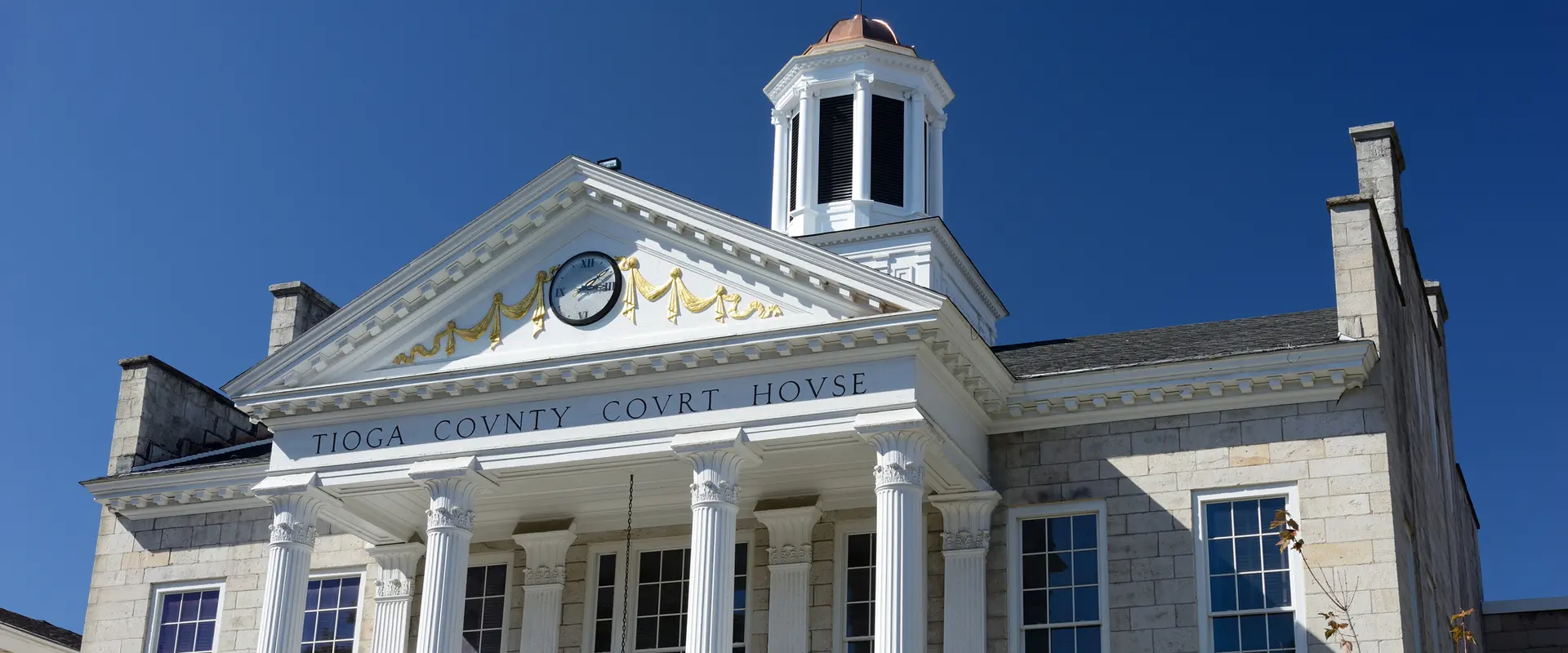
Primary location: Tioga County Courthouse
Magisterial District Courts
The Magisterial District Courts are spread across the county to ensure that people receive justice locally. The courts are at the entry level, responsible for dealing with minor issues that affect people. In most cases, these are the courts people interact with when they have a legal issue. The court handles issues like:
- Civil matters that claim amounts below $12,000
- Landlord and tenant issues
- Evictions
- Traffic citations
- Minor summary offenses
- Preliminary arraignment and hearing for felony and misdemeanor cases
Tioga County has three Magisterial District Courts, with each having a Magisterial District Judge. The courts include MDC 04-3-01 (Elkland), MDC 04-3-02 (Wellsboro), and MDC 04-3-03 (Mansfield), which serve people in specific locations. In case one is not satisfied with a ruling from these courts, they can appeal to the Court of Common Pleas for a new trial.
Primary location: MDC 04-3-01 (Elkland), MDC 04-3-02 (Wellsboro), and MDC 04-3-03 (Mansfield)
How to Access Tioga County Court Records

Court records in Pennsylvania are considered to be public records, meaning they are available to the public. However, a few records have been sealed, like the juvenile cases and some family law matters, for the sake of privacy. Court records can be accessed in person or online, depending on access restrictions.
 Online Access
In Tioga County, people can access court records online through a statewide tool known as the UJS Web Portal. The platform allows them to access index case information by conducting a simple search using criteria such as party name, docket number, or filing date. Also, the portal provides information on the court calendar and on documents filed electronically. Lastly, case tracking can be done using the PAeDocket mobile app on the UJS Web Portal, which simplifies the process.
 Alternative Online Options
If one is not sure which court handled the case they are interested in, the official court sites might not provide what they want. Instead, they can consider using third-party tools like CourtCaseFinder, which allow broader searches across counties in Pennsylvania and beyond. The tool aggregates information from various court websites and puts it in one place, making it easily accessible with a single search. As much as the information is thoroughly researched, it is important to verify the most recent information with the official court website.
 In-Person Requests
Despite the convenience the online options offer, they do not have every record that people might need. For instance, certified copies and those of sealed cases, such as juvenile cases, are only accessible in person. The residents are required to visit the relevant court office to get whatever they need. For cases handled at the Court of Common Pleas, people can visit the Prothonotary/Clerk of the Courts for civil and criminal matters. People who need Magisterial District Court records can visit the MDC office where the case was heard. When visiting any of these offices, one should carry as much information about the case as possible to speed up the process.
 Archived Records
Old records that predate the digital era may not be found online. In most cases, they are stored physically at the courthouse as archives or transferred to the Pennsylvania State Archives in Harrisburg. The time the records are stored or transferred varies depending on the case type and the complexity of the matter. For instance, the serious criminal cases handled at the Court of Common Pleas are retained permanently or for a longer period than the minor cases handled at the Magisterial District Court. Tioga County follows the Pennsylvania Record Retention Schedule to determine the time records are stored or transferred.
For Attorneys and Legal Professionals
Lawyers are an important part of any legal system and need clarity on the local rules in the state and county in which they practice. In Tioga County, attorneys representing the people in civil matters must review the Tioga County Rules of Civil Procedure before filing to avoid missing important details. The Prothonotary/ Clerk of the Courts' offices can help with local rules and procedures.
Also, it is important that the lawyers note that the state has an electronic filing platform within the UJS Web Portal. The portal is known as the PACFile and must be used for certain cases. Also, the site is useful in ensuring they stay on top of their game because it sends automated messages on case updates and scheduling. To access, one needs to register, but some services require approval from the Prothonotary/Clerk of the Courts.
How to File a Case in Tioga County

Tioga County allows its people to seek justice even without lawyers. They have to figure out the process of filing a case, which can be complicated and frustrating for people encountering it for the first time. Knowing the basic steps to follow when filing will make the process less tedious and faster. Below are some general steps that can help people navigate the court process.
 Step 1: Choose the Correct Court
The filer must first identify the court with jurisdiction to hear their case to reduce the risk of costly court transfers. In Tioga County, the process is simple because they only have to choose between two courts: the Court of Common Pleas and the Magisterial District Court. Things to look for are the complexity of the matter, the amount in question, and the geographical location where the dispute took place. The Magisterial District Courts are spread across the county and have the mandate to handle minor criminal matters and civil issues with claims below $12,000, while the Court of Common Pleas has general jurisdiction over any case that is above the Magisterial District Court.
 Step 2: Complete Required Forms
Once one is sure of the court, they need to select the correct form to complete when filing their case. The state simplified the process by providing standardized forms on the forms page of the UJS Web Portal. The site mainly covers court filings for the Court of Common Pleas. For minor issues at the Magisterial District Courts, the best place to check is the website of each MDC office. One needs to be very careful when filling out these forms to ensure they are not rejected. If one is unsure, they can visit the Prothonotary/Clerk of the Courts or the specific MDC office, and staff will provide procedural assistance, but they are not allowed to offer legal advice on a specific matter.
 Step 3: File the Case
Once the forms are accurately filled out, they need to be submitted to the appropriate court office. The Court of Common Pleas documents are submitted to either the Prothonotary or the Court Clerk for civil and criminal cases, respectively. For the Magisterial District Courts, filings are made at the specific MDC office. One should not leave the office without being assigned a docket number, which will be the case identifier in the future. Also, the filing can be done electronically through the PACFile portal.
 Step 4: Pay Filing Fees
The fee one must pay when filing a case varies by case type and court. Claims in the minor Magisterial District Court are usually low, ranging from $65 to $130, depending on the amount in question. Those filed at the Court of Common Pleas are higher and, in most cases, surpass $150, depending on the case type. To be sure of the exact amount, it is safe to confirm with the updated fee schedule. People who may not be able to afford the fee can apply for a fee waiver by submitting a petition for in forma pauperis status with the complaint for the court to review and determine eligibility.
 Step 5: Serve the Other Party
A case is incomplete if the other party is unaware of the lawsuit. The court case was handled, and the type of case is what determines the method. The civil lawsuits at the Magisterial District Court are handled by mail. For those at the Court of Common Pleas, the plaintiff is responsible for ensuring the service is properly effected. The law requires service to be done by the sheriff, a licensed process server, or certified mail. The proof of service must be filed back with the court for the case to proceed.
 Step 6: Monitor the Case
Finally, having taken every step correctly, the court schedules the appearance dates, which parties must strictly adhere to. Noncompliance may lead to a default judgment, dismissal, or an arrest warrant. Use tools such as the UJS Web Portal to track the case. It allows citizens to search for case information, such as the docket number, date range, or party's name, for free.
Tioga County Courthouse Directory
The people of Tioga County are in a much better position to get justice if they have the necessary contact information.
Tioga County Courthouse
It houses the Court of Common Pleas with all its divisions.
Wellsboro
Address: 118 Main Street, Wellsboro, PA 16901
Court of Common Pleas: (570) 723-8380
Orphans' Court: (570) 724-9260
Website: Court of Common Pleas
Magisterial District Courts
Courts that handle minor legal issues. Tioga County has three, spread across different geographic locations, ensuring people get justice locally.
MDJ 04-3-01
201 West Main Street, Elkland, PA
(814) 258-7138
MDJ 04-3-02 Mansfield
267 South Main Street, Mansfield, PA
(570) 662-2904
MDJ 04-3-03 Wellsboro
Tioga County Courthouse, 118 Main Street, Wellsboro, PA 16901
(570) 724-9220
Legal Help and Self-Help Resources
The court expects that all the court processes be done accurately, whether one is self-represented or has a lawyer. To ensure fair justice, Pennsylvania and Tioga County have availed free and local resources to serve the people. Below are a few.
 Free Legal Assistance
The people of Tioga County can benefit from resources like North Penn Legal Services, which provides legal support to low-income families and individuals. Here, they can get help with issues such as housing, family law, consumer debt, elder law, public benefits, and domestic violence. The other option is the Pennsylvania Legal Aid Network, which plays a critical role in connecting individuals with available resources to take them through their cases.
 Local Legal Support
Locally, people can benefit from the Tioga County Court Administration office, which provides basic procedural guidance and helps them obtain the correct forms and complete them accurately. Also, the UJS Self-Help Center offers guides, videos, and packets for people without lawyers. The tools include plain-language guides that help people throughout the filing process. Lastly, the Pennsylvania Bar Association Lawyer Referral Service can connect people to lawyers practicing in the county at a low initial cost.
FAQs
How can I find out if someone has a court case in Tioga County?
The easiest way to find out whether someone has a court case is to use available online tools. First, the UJS Web Portal offers access to free public docket sheets for Common Pleas and Magisterial District Courts. CourtCaseFinder is an alternative online tool that collects information from official court sites and makes it available to the public who want to conduct a broader search beyond Pennsylvania.
What is the difference between the Court of Common Pleas and a Magisterial District Court?
The huge difference between the two courts is the jurisdiction. The Court of Common Pleas is the highest trial court with general jurisdiction over all matters not heard by the other courts. It handles serious felony criminal and civil matters of claims above $12,000, domestic matters, and probate issues. On the other hand, the Magisterial District Court handles minor issues affecting people daily at the local level, such as traffic infractions and preliminary hearings.
Are Tioga County court records available to the public?
Yes. The majority of the court records are available to the public because they are considered public records. But there is an exception in some cases that have been sealed, such as juvenile and family cases, to ensure privacy. If one needs access to the restricted file, they may need to visit the appropriate court office where it is kept.
What if someone misses a court date in Tioga County?
Court dates set by a judge require full adherence. Noncompliance may lead to a default judgment, dismissal, or an arrest warrant. Use tools such as the UJS Web Portal to track the case. It allows citizens to search for case information, such as the docket number, date range, and party names, for free and provides access to case index information. This will ensure they do not miss a case date, which can interfere with the justice process.
How do I get a certified copy of a court record in Tioga County?
In Tioga County, certified documents are among the few that are not located online. To access them, residents must visit the relevant court office to obtain what they need. For cases handled at the Court of Common Pleas, people can visit the Prothonotary/Clerk of the Courts for civil and criminal matters. People who need Magisterial District Court records can visit the MDC office where the case was heard. When visiting any of these offices, one should carry as much information about the case as possible to speed up the process.
Other Counties in Pennsylvania
- Adams
- Allegheny
- Armstrong
- Beaver
- Bedford
- Berks
- Blair
- Bradford
- Bucks
- Butler
- Cambria
- Cameron
- Carbon
- Centre
- Chester
- Clarion
- Clearfield
- Clinton
- Columbia
- Crawford
- Cumberland
- Dauphin
- Delaware
- Elk
- Erie
- Fayette
- Forest
- Franklin
- Fulton
- Greene
- Huntingdon
- Indiana
- Jefferson
- Juniata
- Lackawanna
- Lancaster
- Lawrence
- Lebanon
- Lehigh
- Luzerne
- Lycoming
- Mckean
- Mercer
- Mifflin
- Monroe
- Montgomery
- Montour
- Northampton
- Northumberland
- Perry
- Philadelphia
- Pike
- Potter
- Schuylkill
- Snyder
- Somerset
- Sullivan
- Susquehanna
- Union
- Venango
- Warren
- Washington
- Wayne
- Westmoreland
- Wyoming
- York
Table of Contents
